Wednesday, November 11, 2015

William J Schell


Cindy and Jim contributed to the war memorial constructed in Wadena, Iowa. They had dad's name placed on the wall there. 


William was born in Quincy, Illinois on September14, 1925 to parents Carl J Schell and Beatrice Markus Schell. He enlisted for service in the US Navy at Springfield, Illinois on August 28, 1943. He would not be 18 until September of that year; so he must have had to get parental permission to enlist. After spending some time at the Great Lakes Naval Training station, he went to fleet sound school at Key West, Florida where he received training to be a sonarman. He was assigned to the USS Eugene Elmore was was stationed at Boston in February, 1944. The Elmore was a destroyer escort and he would serve aboard that ship for almost his entire naval career. In December, 1945, he was released from the Elmore in  San Diego, California and reassigned to the USS Albert W Grant stationed in Seattle, Washington on March 15, 1946. His date of separation from the Navy was March 22, 1946. His total service was 2 years, 6 months, and 25 days.
     While in the Navy, he saw service in both the Atlantic and Pacific theaters of war. The Atlantic service came first. It appears they were escorting ships across the Atlantic mostly to North Africa. One of the highlights of his entire service had to be  on May 29, 1944. They were located near the Azores off the northwest coast of Africa. A German U-boat attacked the American air craft carrier, USS Block Island and sank it. This turned out to be the only American carrier lost in the Atlantic. The USS Ahrens, another destroyer escort in the flotilla, rushed to help rescue survivors from the Block Island. She also got a fix on the U-boat and signaled the Elmore with the coordinates. The Elmore moved into position and located the U-boat. They  attacked and destroyed the sub. William was a part of the sonar crew on duty during this skirmish. I found in the log books for the ship that he and the rest of the crew received special commendation for their work in putting an end to the U-boat. 
  In November, 1944, the Elmore was reassigned to duty in the Pacific. In December, they were stationed in Dutch New Guinea, just north of Australia. They left for Lingayen Gulf in the Philippine Islands in December, 1944. After patrolling the area around Leyte and Luzon in the Philippines, they headed back to Dutch New Guinea at the end of February, 1945. In March, the Elmore left for the Philippines again, this time escorting the USS Montezuma Castle. The last ship log I have is for March 27-31, 1945 and the Elmore is anchored for repairs at San Pedro Bay, Leyte, Philippines. William is back in San Diego by December, 1945; so what occurred between March and December, 1945 is unknown to me at this point. In reading through the ship logs, they had several Japanese sub sightings and even had to contend with Japanese kamikazes in their vicinity. Their ship had no major encounters with either subs or kamikazes. It appears from the ship logs that they were primarily escorting other ships from  Dutch New Guinea to the Philippines and around the Philippine  islands of Luzon and Leyte. 

William “Bill” Schell married Patricia Happekotte on May 30, 1947 in Quincy, Illinois at St. Francis Catholic Church. 


When I was in San Francisco this October, I walked across the Golden Gate Bridge. On the north end is a place called Vista Point; people can pull into this area and see a great view of not only the bridge but also of San Francisco. This statue is at Vista Point. Many sailors left from San Francisco and what you see from Vista Point is what they would have seen as they headed out to sea. I don't have any evidence that dad was ever in San Francisco as his ship sailed from the Atlantic through the Panama Canal and headed straight for the Dutch East Indies (now called Indonesia). When he came back at the end of he war, they landed in San Diego. From there they went to Seattle where he was discharged. I don't know if they spent any time in San Francisco on their way to Seattle. But I thought this statue and its inscription was very appropriate to show on this Veterans Day, 2015.


Next: Tribute to James Schell, dad's oldest brother.

I have a blog on the maternal side of the family at happekotte.blogspot.com

Tuesday, November 10, 2015

Veterans Day Project

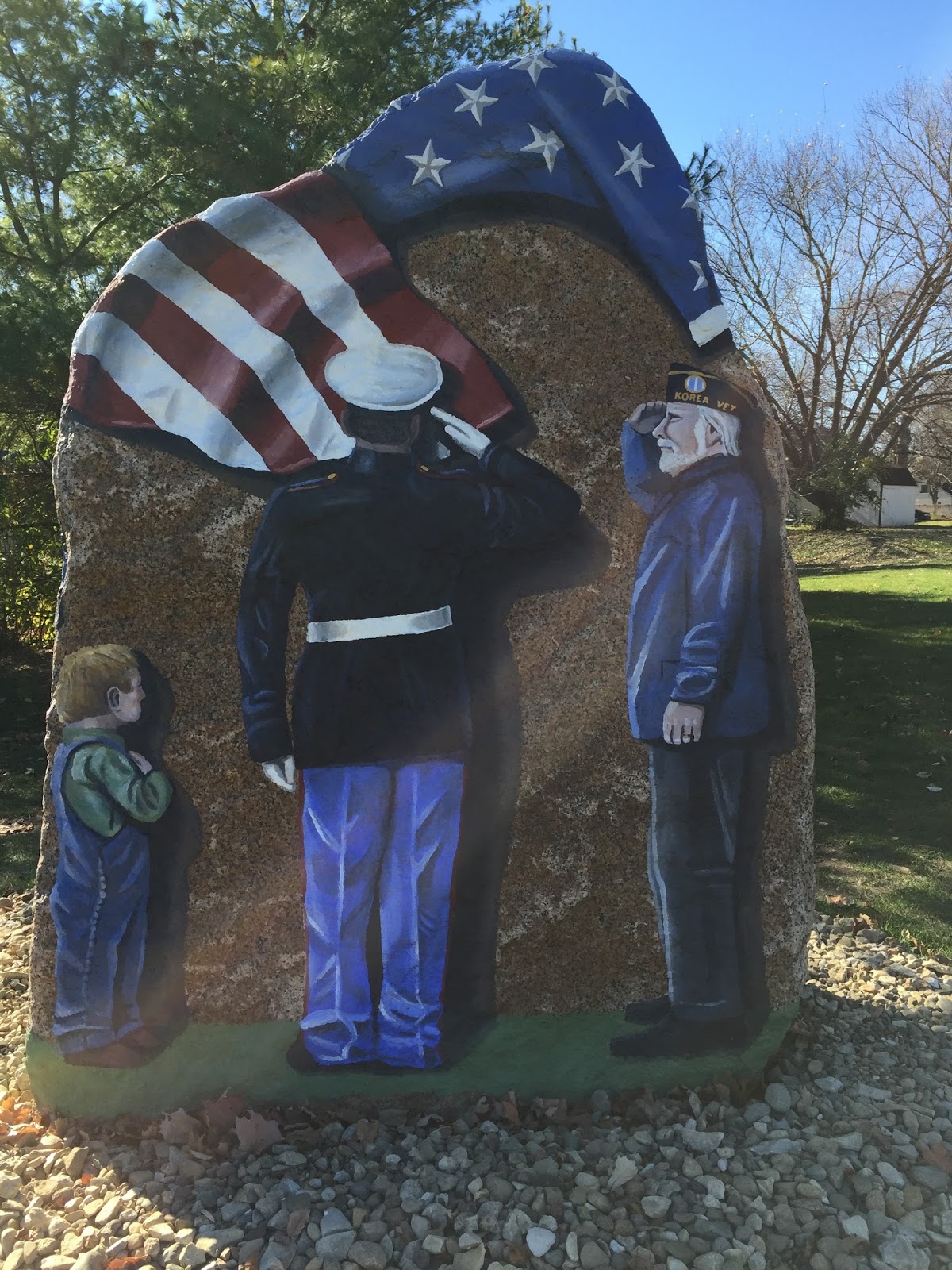
Tomorrow I am going to start posting short stories of paternal ancestors who have served in the US military in some capacity. I know I have not found all but I will continue the search! The bricks pictured above are in the Veterans Park in Cedar Falls, Iowa. It was just a coincidence that the brick for Roger Heald was placed so close to dad's brick! Roger Heald is the father of Mike's wife. The next series of pictures shows the just-completed Freedom Rock also located in Veterans Park. The artist is Ray Sorensen and he is endeavoring to paint a Freedom Rock in all of Iowa's 99 counties.                                                                                                                                                                                                                                                

The side pictured to the left is of Cedar Falls' own Taylor Morris. He lost all or parts of four limbs while serving in Afghanistan.


Taylor Morris story


The next side depicts Waterloo's own Sullivan brothers who all were serving aboard the USS Juneau went it was attacked in the Pacific during WWII.

Sullivan brothers' story


The next side honors the those who served in the Korean War. 


The last side honors Robert Hibbs who lost his life serving in Vietnam. The Main Street Bridge here in Cedar Falls is named after him.
                        Robert Hibbs' story


I will also be posting veterans from the maternal side of the family at  Happekotte Happenings


Thursday, June 11, 2015

Bernard Husum, America-bound in 1855

Bernard Husam was my two-times great-grandfather. He was born Johann Bernard Husam in the little village of Albersloh. This small village is located a little less than 8 miles southwest of modern-day Münster, Germany (see map below). When Bernard was born, the area was the Province of Westphalia and a part of the Kingdom of Prussia. I am indebted to June Markus Hoopes, who traveled to Germany about 1986 and collected some genealogical information on the Husam and Markus families. From a pedigree  chart that she constructed, I learned that Bernard was born on 7 February 1825. From that information I was able to find the microfilm of that record. His parents were  Johann Theodore Husam and Anna Maria Catharina Husam. One very interesting observation is that Bernard’s father, Johann Theodore, was actually born with the surname of Grosse Minerup! In some cases, the husband took the surname of his wife [Husam] if she had inherited property. This may have happened with Johann Theodore!
 
To understand why Bernard may have come to America, you have to understand the world in which Bernard came of age. He was age 23 when there were revolutions in central Europe. After Napoleon was defeated in 1815, there was a conservative push to return Europe to the control of the “rightful” monarchs who Napoleon had defeated. The Austrian Empire led this charge, but at the same time, Prussia was seeking more power. The liberal revolutions of 1848 that attempted to spread democracy were defeated and that  sent many people packing to the United States. I do not know what part, if any, that Bernard may have played in this conflict. He was old enough to be in the military at that time and he may have been. I have a clue but no evidence that he was in the military in Prussia. A letter dated 25 March 1898 was sent to Bernard from his nephew, Anton, who lived in Albersloh in 1898. In this letter to his Uncle Bernard, Anton states, “Your army picture from Potsdam ’48 hangs in our living room, and we take good care of it.” To me, this indicates that he was in the Prussian army in 1848. I can only speculate it was the Prussian army because Potsdam is located near Berlin.

I have several other letters that were sent to Bernard from relatives in Albersloh and the area. My Aunt Hansi [Joan] Schell painstakingly translated them all several years ago and I have used them several times in researching the Husam family. There are thirty letters dated from 1866-1901 and an archivist at our local university advised me on how to best preserve these treasures. I have scanned them and put them on a CD.
 
Bernard stated on the 1900 US Federal Census that he arrived in America in 1855. He was 30 years old at that time. It is very possible he may have left to avoid any further military service in Prussia. He was probably still eligible. However,  I remind you that that is purely speculation at this point. But for whatever reason, he did leave Prussia in 1855. I have a passenger record for a “Bernhard Husum”, age 30, a farmer from Prussia arriving in New Orleans on 30 November 1855. Most everything points to this being our Bernard- he is the right age, he is from Prussia, and it agrees with the information he gave the census taker in 1900. But there are a couple of problems that I have not worked out yet. Along with him was an Anna Husum, age 26 and another Anna, age 3. It could be a wife and daughter, but he married Elizabeth Jacobskötter in 1858 in Adams Co., Illinois and probably in Quincy. So, if this Anna was a first wife, there should be a death record in Adams County. Anna could also have been a sister traveling with him and later returning to Prussia. 

Another problem with this passenger record is the intended destination.....Cincinnati! It is very possible he could have changed his mind. He could have met someone aboard the ship who was headed to Quincy. It will be interesting to check that passenger list more carefully to see if someone else is heading for Illinois and shows up in Adams County. I have not done that research yet- it will take some time and perserverance.  Again, all of this is speculation. But that’s what makes genealogy so much fun…..searching for the answers to these mysteries!

As I speculated before, Bernard may have come to America to avoid further military service in Prussia. But if that was his reason, he didn’t escape military service. By 1865, he is a soldier for the Union army in the Civil War. Stay tuned….that will be the subject of my next post.


Saturday, March 21, 2015

Adam Kolker's Ordeal in 1853


I apologize for having been remiss in not posting on this blog for sometime. I have been involved in Thomas MacEntee’s “Genealogy Do-Over” project. In my case, it has not been an actual “Do-Over”; it’s been more of a “Go-Over”. I went back to the start to check my source citations and, as Thomas MacEntee said, many start out in genealogy and fail to do a good job of source citation. He was so very right! So, I have been going back and developing more accurate citations for ALL of the documents and information that I have come across so far. That has taken a lot of time and effort. But while I was at it, I also filled out research logs and made To-Do lists for each family. That has taken just as much time and effort. But I have to say, I’m a heck of a lot better organized now!

Back in August, 2013 I had a blog about Adam Kolker, my two-times great grandfather who was born near Fulda, Germany about 1835 and as an eighteen-year old came to America in 1853. He was aboard a ship called the New Era which had between 300-400 German immigrants aboard. On the night of November 13, 1853, the ship ran aground on the coast of New Jersey near modern day Asbury Park. Only 160 survived the ordeal with many just being washed overboard during the stormy night. Adam recalled in a Quincy newspaper, that he had survived by clinging to one of the ship’s masts. What a harrowing night that had to be.

I was fortunate enough to find an account of Heinrich Weckesser, who was also a survivor. He was also age 18 and, like Adam, survived by clinging to a mast. His story below must be very similar to what Adam experienced- who knows…. perhaps they were clinging to the same mast!


Grandpa Henry's Story

Heinrich Jacob Weckesser, age 18 [in 1853] from Hatzbach, Germany

Based on the various firsthand accounts of the wreck that are recorded, Henry might have described his experience like this: [This sounds like it was not written by Henry himself, but a reconstruction by someone else from sources describing the actual ordeal.]

It wasn't until after the wreck that I could begin to comprehend something I had actually seen with my own eyes. Of the few survivors who did not spend thirty-six hours clinging to the rigging of the wrecked ship, Captain Henry [Thomas J Henry, commander of the New Era] was one. He was on dry land, safe, while the screams of his charges were swallowed up in the ocean's roar.

I thought back to how we had begun, to the excitement that bounced around the ship as it filled with chattering families, claiming their space in steerage, setting up privacy curtains, arranging sundries, journals, snacks in cheerful optimism. As the days wore on though, and cholera struck the ship even while we waited in port, the urgency to set sail took on a grim quality.

Relief swept over me on September 28, when we finally nudged our way through the harbor to open sea. I watched Bremen disappear, raised my eyes to Heaven for God's good keeping, and leaned into the wind. 

But the going was slow. The ship leaked. And people kept getting sick. I told myself every day that it was going to get better. We were going to get a tailwind, a break in the clouds, a day without another passenger down.

By the end of the voyage, cholera would take forty lives from among us as we rocked across the sea. We watched, shivering, each time another body was wrapped in a thin blanket and slung overboard. My own two blankets were confiscated as makeshift cloth coffins, after which I slept in every piece of clothing I had stuffed into my trunk, trying with little success to stave off the bite of night's deep freeze.

Day after day, we sailed into the wind, seeming to get nowhere. Four weeks in, a gale hit and within minutes threw waves clear across the deck. Food, stoves, supplies- all swept overboard. Three souls were lost that night.

When our rations were reduced to one meal per day, we began to talk to each other less about our plans for America, more about our families back in their villages, who would be settling in now for winter's cold. Nights I longed ashamedly for the fires of home. When we were down to one meal every two days, we began to sit in stillness about the deck, clustered in small groups, talking little, conserving energy.

My eighteenth birthday passed, unobserved. Perhaps Konrad was toasting me back in Hatzbach. I hoped my brother imagined me safe and warm, with a full belly, my face still glowing with the spirit that had warmed it as I had taken leave of him and home.

I barely slept that last night knowing we were finally approaching New York City. I dreamt of sausage and sauerkraut, of bread and cheese and eggs, of cold milk and hot cider. 

We should have risen to find ourselves in port celebrating. Instead I was jarred awake, disoriented, as six weeks of rocking lurched into a sudden, shuddering tension. I jumped up and walked straight into the wall, fumbled for the door, found my way to the deck. 

Chaos. The captain was barking orders, yelling to the passengers to stay below, even as sea water poured across the deck. I lost my footing in the mad scramble, an elbow jabbed my head. I tore my knee on the rough deck boards as I fought to right myself and rise above the salty gush.

I felt no sting from my slashed knee, nor did I feel the burn of the rope as I caught hold of the closest mesh of rigging. Coughing and spitting, I pulled myself up instinctively, one hand over another. Up, up, until the water broke across my shins, and higher, out of reach of the sea's rough tongue.

I did not stop until there was nowhere else to go, and leaning my torso into the wind to steady myself. I wrapped both arms around the beam. I looped one leg over the lashing rope, one arm under the other leg, until I was bound in crisscrossing ropes. They rubbed against my shirt and across my wet skin with every fierce shudder of the ship, but when the wind was right my weight rested against the beam for a few seconds.

From this pained perch, I turned my head dizzily to see what was happening below. I could not bear to look for long. I cannot bear to remember every detail, though many of the sights still haunt me.

The surf rolled across the ship as if the deck were a strand of beach in high tide. Some of my fellow passengers were climbing; some were clinging to each other, unable to hoist themselves out of reach, gulping for air as they were clobbered by waves of water every few seconds. One woman jumped straight up with each crest. In another place, she would be laughing, playing at the seashore. Here, her face twisted in horror. 

As they gave up the fight, bodies went limp and were battered about, a few lifted up and over the rails with each rhythmic wave. The silver hair of an old man flared in the water. A baby, tossed over the deck rail and back, like a doll in a careless child's game. A muscled man, shirtless and limp, rolled over and over in graceless somersaults.

I squeezed my eyes shut; began beseeching God.

A cannon's distant roar. A lifeline shot over our heads dropped into the rigging. Beneath me, the crew scrambled to secure the line before it slipped back into the sea. 

I squinted and shook water off my face, straining to see as the shape of a small boat formed in the fog, inching closer to the crippled ship. Our first hero appeared as an angel from heaven manning this little boat; a dark-haired young American in a heavy raincoat. He was grabbing the line hand-over-hand, guiding the small boat over the rolling waves toward us.

As the lifeboat approached the ship, Captain Henry steadied himself on the lifeline directly below me. He turned and looked over his shoulder at the bodies floating and washed against the rails. He gazed up at the rigging; at his passengers, who had scampered up the ropes like rats escaping the wrath of the ship's cook. 

Captain Henry shook his head. Water dripped from his chin, and I saw his jaw clench, again and again. He looked up, met my eyes and cringed. And then he was gone. Over the rail, into the ship's shadow. 

When the lifeboat emerged inching back toward the shore in the gray light, Captain Henry was in it, with half a dozen passengers and crew. The boat bounced violently. Arms rose up like sea serpents, grabbing for a berth, but the crew beat them back. They kicked them away, falling into each other, until a wave caught the boat and spilled the whole lot of them into the churning sea. 

Heads popped up, gasping, and spitting. Four or five men clung to the capsized boat and kicked toward shore. Captain Henry's face was among them. 
. . . . . . . . . . . . . . . . . . . . . . . . . . .
 Grandpa Henry's story ended here, not telling how they were finally rescued. Captain Thomas J Henry and crew shamelessly abandoned ship, leaving the immigrants to fend for themselves until help finally arrived. The following link is to a report published  in 1907 that goes into greater detail about the disaster and the eventual rescue.

https://theneweraprojectdotcom1.files.wordpress.com/2012/06/sacshe-article-on-new-era.pdf