Wednesday, April 30, 2014

John Schell, Sr.- the Original Schell Immigrant


Arrow shows Schell ancestral area
John Schell, Sr. was the head of the first of our Schell family lines to come to America. Back in Germany, he was known as Johann Schehl. I am not certain as to why or who changed the name. It could have been to Americanize the name, but I do not know that for certain. Johann was born in Erfweiler, Pfalz, Germany on May 16, 1788. One year after Johann’s birth, this area would come under the control of Napoleon. He would continue to control the area until his defeat in 1815. After that, this Pfalz region was actually a part of the Kingdom of Bavaria. The Pfalz region of Germany was called Rhenish Bavaria. The word “Rhenish” refers to its location near the Rhine River.  I was privileged to have been able to visit Erfweiler in the fall of 2013 and you can see some pictures of it in my earlier posts on the trip to Europe.
Napoleon

This next part is taken from a biography in an Adams County, Illinois history book. I warn you that much of this has not been corroborated, but it is quite a story about Johann before he came to America. If it is true, it could certainly explain why he would have wanted to leave this part of Germany. I also do not know who provided the information as this book was printed well after Johann had died.

Johann, it is claimed, had served in Napoleon’s army for eleven years. The area was under French control; so he may have not had a choice. It says that he served in Spain (The Peninsular War: 1808-1814). That could be true as he would have been age 20 in 1808. He was taken prisoner by the Spaniards and treated brutally. The Spaniards said they would release him upon the condition of him joining the British army. Britain was Spain’s ally in this war. Johann agreed and the British sent him to Canada for three years. He was eventually released and returned home to Germany. That is quite a story if true!

After he returned, Johann married Barbara Zwick on February 17, 1817.  Barbara  was from the nearby community of Bruchweiler. They had a daughter, Appolonia born on May 2, 1819 followed by son, John, Jr. on June 7, 1821. They would have two more daughters, Barbara and Margaretha, who died as infants. According to church records, there was another son, Friedrich, born on July 17, 1827 and I have not been able to find out what became of him. He was not with them in America and I suspect he may have died young also. I just have no proof of that yet.

The Schehl family would leave for America in February of 1832 and I will continue with that story in my next post.


Sunday, February 9, 2014

Peter Schell

Sadly, we are getting to the part of my family history where there are no pictures. I will make an attempt to include a map, chart, or something of interest to add to the story where possible. 


 My last post on the paternal side was about Peter Florian Schell. This post is about his father Peter. He was born in LeHavre, France on December 13, 1828. The family was awaiting their departure for America. The family arrived in New York City on March 15, 1832 aboard the ship Edward Quesnal. While in New York, the family had a daughter, Phillippine, born on November 25, 1833. A biography in an Adams County history book claims they left for Quincy, Adams County, Illinois in 1835. I have a book about St. Boniface Catholic Church in Quincy which has a list of the original members and it says the family arrived in Quincy in 1836. I will have more to say in a later post about Peter’s father, John, that will have more details about  the family coming to America.

Peter married Sofia Sanders (Zanders) in Quincy on July 5, 1853. They had three sons: Reinold (my great grandfather) who was born in 1856, Peter Florian (from the last post) born in 1857, and George who appears to be a twin of Peter Florian but dies before attaining his first birthday.

The real tragedy of this family happens on March 13, 1858 in Quincy when Peter dies at the age of 29 of small pox. The Quincy Daily Herald had the following obituary on March 16, 1858. They had quite a flowery way of putting things back then:

“Death of Peter Schell- We regret to be compelled to perform the melancholy duty of chronicling the death of this worthy man. He died at the residence of his father, in this city, on Saturday last, of small pox. He was a young man of sterling worth, and was universally esteemed. His funeral took place on Sunday, and his mortal remains were followed to the tomb by a large concourse of citizens who had known and appreciated his many virtues”

He died very young, but thank goodness, he had a few children before his passing. Otherwise, I wouldn’t be making this report! It always amazes me how fate plays such an interesting role in family histories. 

The chart below shows the Schell line from my father, William, to Peter

Monday, January 13, 2014

Our Tinman- Peter Florian Schell


Peter Florian Schell lived his entire life in Quincy, Illinois. He was born on October 27, 1857. I am thinking he had a twin brother, George, who apparently died in infancy, but I have no proof of this yet. Peter also had another brother; Reinold Schell, who is my great grandfather.  Peter’s parents were Peter Schell and Sofia Sanders Schell. Peter Florian died on November 17, 1929.

Peter was a tinner by trade. If you look at the hat that he is wearing in the picture below, it looks to be metallic. My uncle Mark Schell thinks it could have been a ceremonial hat for parades. Quincy seemed to like parades a lot. I have run across many stories about all kinds of parades they had there- mostly in the late 1800s and early 1900s. So, this hat could very well have been for that purpose.

Pictured below is a combination of Peter F and Reinold Schell’s families. The only one not pictured is Reinold; so I assume he is the one taking the picture. From the left to the right and standing in the back are Cornelia and Florence- both daughters of Peter, then comes Peter Florian in the shiny hat, Helen and Pauline, both daughters of Reinold. All the children in the front are Reinold’s. The children, from left to right, are Paul, Rose, Carl (my grandfather), Eugene, and Coletta. The first woman on the left has not been identified, but I am inclined to think it may be Peter and Reinold’s mother, Sofia. The next woman I believe is Peter’s second wife, Frances Werneth. The third woman is Reinold’s wife Sophie Helen Kolker Schell.


As I mentioned above, Peter’s second wife was Frances Werneth. His first wife was Matilda “Tillie” Grether and she was the mother of nine children born between 1878 and 1890.

Peter is also the great grandfather of Terry Emerson, the cousin we found through genealogy living in California. I have mentioned Terry in a previous posting January of 2013; it was at the beginning of this blog and only my second posting. You can see it again in the archived postings on the right side of the blog page.

Monday, December 16, 2013

European Adventure- Part 4

Sorry about the lateness of this post! I had it on my site; just forgot to click the "publish" button! 
 
Here is the final installment of my European adventure. We arrived back in Amsterdam on Sept. 16 for our flight home on Sept. 19. Therefore, we had some time to do some more exploring. The weather was kind of chilly and damp but that did not deter us. At the left is the Anne Frank home. You cannot truly appreciate the cramped conditions in which they lived unless you actually go through that upper floor. It was a very sobering experience.
 

My favorite pastime in Amsterdam was strolling along the canals. There are so many neat little shops and cafes along the way. I can't help but wonder how many cars they have to fish out of these canals! There isn't always a guard rail to stop you. There are flowers everywhere- on the bridges and in window boxes. 


I took this picture to show how some buildings are settling. You can see where one of the buildings is leaning forward. There were many places where either the left side or the right side is higher than its opposite. That probably makes opening a window alittle difficult!  

 The above picture is the Rijksmuseum which is the Netherlands' national museum. You could easily spend a day going through the exhibits. The highlight is the painting "Night Watch" by Rembrandt. I'm not a real artsy person, but you cannot help but be impressed by seeing  the actual  works of art that previously you had  seen only in pictures, videos, and history books.  One interesting sidelight of the museum is that entrance you can see in the picture. The two middle entrances are actually bike lanes that pass through the building. Apparently, the museum director attempted to have those lanes closed to bikes, but the bike "lobby" is so powerful in Amsterdam, it was kept open to bikes. If you could only see how many bikes there are, you could readily understand the power of the bike lobby! The city has a population of 800,000 people and there are 880,000 bikes! Yikes!

This last picture below was an amusing "find" for us. If you cannot read what is inscribed at the top of this structure, I repeated it in the picture's caption. The Latin phrase means "Wise men do not pee into the wind". Why does it say that, you may ask? This was a commercial building project in Amsterdam. The developer was having a lot of difficulties with the permit process. So, he submitted this phrase to the city fathers, who apparently, didn't pay much attention to what it meant and approved it! This was a way for the developer to get back at the city for making the process so difficult!
Homo Sapiens Non Urinat in Ventum


Well, the 19th came about and it was time to leave. We took a taxi out to Schiphol International Airport and it was soon off to Chicago on a nine hour flight. We arrived in Chicago around 1 PM and were to have a couple of hours before the connecting flight to Iowa. We got coffee and a newspaper to catch up on the news. I happened to look at the display of flights and noticed that our flight had been canceled along with many others. I will not get into the nitty, gritty of what transpired after that, but I was not a happy camper! My travel partner got to see an irritated side of me that he didn't know existed! We spent from about 2 PM until 8 PM that evening trying to figure out  connecting flights and getting accomodations for the night. The next morning, we were on a shuttle from our hotel in Schaumburg, IL back to the airport at 6:30 AM. Got to got through security again.....fun! Finally after a short delay because the flight crew was late in arriving, we were off to  the Cedar Rapids airport and the end of a truly amazing trip.

Sunday, November 24, 2013

European Adventure- Part 3


In the map to the left, the green colored area is the state in which Erfweiler is located. In the map above, you can see where Erfweiler is in relation to Frankfurt and Stuttgart.


Inmy last post, we were in the Schell ancestral village of Erfweiler in Germany. We had enjoyed a great meal at a local eatery called the Jägerhof. The next morning, we were invited to Gerhard and Bärbel Zwick’s home for a typical German breakfast consisting of a variety of cheeses, thin-sliced meats, rolls, and coffee. After breakfast, Gerhard and Friedbert took us on a walking tour of Erfweiler. They pointed out some of the buildings and homes that would have been around when our ancestors plied the streets of Erfweiler back in the 18th and 19th centuries. They showed us the old school that Johann Schehl would have attended and the site of the old Catholic church that the family would have attended. We also got a little insight into Erfweiler during WWII. Since the town is very close to the French border, the Nazis ordered all villagers to evacuate for seven months after the war began in September of 1939. Near the end of the war when the Americans occupied the area, all the villagers in the upper old town had to evacuate so the Americans could set up camp there. Gerhard had a relative in Erfweiler who was killed after the villagers moved back in. He, unfortunately, came into contact with a grenade that had been left behind. Gerhard also had a relative who was killed during the D-Day invasion and another who was killed when German paratroopers tried to invade the island of Crete. We visited a town
Honoring town's war dead- there were two more plaques
cemetery with little hope of finding any tombstones of my ancestors. They do it a “little” differently in Germany. You lease a plot for between 15-25 years. After the lease is up and if no family member renews the lease, the plot can be re-used! What happens to the remains that were there, you say? Well, there are not many remains as they do not place coffins inside a liner. But if there are remains, they are just buried deeper! The headstone is removed and a new one is put in place. They even recycle the headstones. So, there are no headstones remaining for the dearly departed from long ago! We did find a Schehl gravesite but it was from a different line.

After the tour, it was time to return to Gerhard’s home for lunch. They had said the night before that we were going to have a “special” lunch on Sunday and then they started chuckling. That was of some concern to me; why the chuckling without explanation? Well, we got to the lunch after our tour. There was a large platter of sausages and brats, bread and rolls, a large bowl of sauerkraut (which was of special concern to me), and then a large sausage-like piece of meat on a large plate. It was probably about 4-5 inches round and maybe about a foot long. They said it was somewhat unique to this Pfälz region of Germany and it was called saumagen, which didn’t mean much to me. So, they sliced it and gave each of us a piece. I dug in and it was quite delicious. It was only after that that they explained that saumagen meant “sow’s stomach”! It seems that they stuff a sow’s stomach with a mixture of pork, potatoes, and seasonings; it resembles a meatloaf. The sow’s stomach is merely the casing for this large sausage. It really was quite good, but I don’t think that’s one thing I will soon try to make at home for (what should be) obvious reasons. After lunch, Gerhard and Bärbel took
Climbing around Alt Dahn ruins
From highest tower of Alt Dahn
to us to the neighboring town of Dahn. High on a hill overlooking the entire valley is an old castle called Alt Dahn. It is now a state park. It’s a pretty good hike up to the remains of the old castle from the parking lot. It was kind of misty that afternoon but you could see for a long way up there. After returning to Erfweiler, it was time to head back to Stuttgart with Friedbert and Gudrun. They dropped us off at our hotel and said they would come by in the morning and take us to the main train station downtown.

The next morning, we said our goodbyes and left for Amsterdam for our last German rail experience. Everything went well, except we had not made reservations so we wound up standing (with others) for part of the trip until many disembarked along the way. In Köln (Cologne) I had another encounter with German culture that I’m not used to. We had a little time to wait in Köln while waiting for our connection. I went downstairs to use the restroom. I was not expecting a couple of older women to be in there cleaning urinals while the area was being used! So, I just pretended to be German and went about my business “seemingly” unperplexed! Our connection to Amsterdam soon arrived and we were off to our final European destination before heading home. The next post will cover our last couple of days in Amsterdam and our unexpected confusion at Chicago’s O”Hare!

Have a Wonderful Thanksgiving!

Monday, November 4, 2013

European Adventure- Part 2


Fabian, Gudrun, & Friedbert Schehl
When I left off last time, we were enroute by Eurail from Nürnberg back to Stuttgart. Upon arrival in Stuttgart, we headed back to the Hansa Hotel which is the same place we had stayed at the first time in Stuttgart. It’s not far from the train station, it’s in a quiet neighborhood, and it’s inexpensive! I called our cousin, Friedbert Schehl, who lives only eight blocks from our hotel. I had found Friedbert in my genealogy search and this would be our first face-to-face meeting. By the way, he is our seventh cousin. Our common ancestor is a sixth great grandfather. We were to go to Friedbert’s apartment for dinner that evening. He came and picked us up and I have to say, his English was not bad! At least, we were able to pretty much understand him. His English is a lot better than any German I knew. He had invited his son, Fabian, over to join us and act as translator, if needed. His wife, Gudrun, was preparing kasespätzle for dinner. It’s like a cheese and noodle casserole and was very good. Friedbert and my travel partner hit it off very good; both are big Bob Dylan fans! After a lot of talk and filling in details of our lives, it was time to head back to the Hansa. Tomorrow would be VERY exciting. Friedbert and Gudrun were going to drive us two hours to the west to Erfweiler, the Schell/Schehl ancestral village.
Schloss Solitude

We left midday for Erfweiler. Just outside of Stuttgart is a place called Schloss Solitude; it was a palace built by a noble as his hunting lodge. Some lodge, huh? Next it was on to one of those famous autobahns. We were traveling along at about 85 mph and cars were zipping by us. After crossing the Rhine, we entered an area that had many vineyards. We actually took a little side trip and crossed the French border to the town of Wissembourg. It’s another very charming medieval-style village. Gudrun went into a bakery and got a loaf of French bread and we just walked around town looking at the sites while tearing off pieces of bread! After spending about an hour, it was time to head off to Erfweiler, a mere fifteen minutes away.
House in Wissembourg


Wissembourg


Erfweiler is a very small village of about 1,200 people. I would call it a bedroom community as most people work outside of town. There are only small businesses in town. We went directly to the home of Gerhard and Bärbel Zwick. Gerhard is the first person I was able to contact in Erfweiler over the internet. And it so happens that he was a boyhood friend of Friedbert’s. They had grown up together in Erfweiler. It was Gerhard who put me in contact with Friedbert.
Gerhard & Bärbel Zwick
Gerhard has a doctorate in chemistry and actually works in Karlsruhe, about an hour away. They live there during the week and are in Erfweiler for weekends. Gerhard speaks very good English because his job takes him all over the world and English is a common language for businessmen in Europe. We weren’t at the house very long before Friedbert and Gerhard took me on a hike through forests and up to the top of some rock formations that overlook Erfweiler. These forests had been their playground in childhood. The next day when we took a walking tour of Erfweiler and, today, on the forest hike, it was an indescribable feeling walking the same streets, hiking the same roads, and seeing some of the same buildings that my ancestors had seen. This would definitely be the highlight of my trip. Once we got back to Gerhard’s house, we had a little rest...a glass of beer and
Friedbert & Me above Erfweiler

Forest going to overlook
Gerhard showed me some of the photos of the town that he had on his computer. After about an hour, it was getting to be dinner time. Steve M had gone to our guest room located down on the main street in town. We all walked down town to get him and then go the a wonderful little German restaurant in town called the Jägerhof. I decided to get adventurous again and have something I had only heard of but had never had....sauerbraten. I was not disappointed! I decided this is something I would attempt to make back home (and I did!) That evening was so much fun. It was fun sitting back and
Jägerhof Restaurant
listening to the two families chat back and forth in German. I had no idea what they were saying but it was so much fun just listening. And they were so kind as to stop ever so often and include us in some English conversation. We wound up being there very late.....actually the waitress had left for the night and the proprietor (a friend of Gerhard’s) allowed us to stick around. There were more drinks to be had and I had the chance to experience something else for the first time.....I had never had schnapps! Finally, it was time to head back to the guest room and get some much needed sleep. Tomorrow would be Sunday and time to head back to Stuttgart before making our final train trip back to Amsterdam and our flight home. That will be in my next post.


Thursday, October 24, 2013

European Adventure- Part 1

At my house just before leaving
As I mentioned in my last post, I had made a trip to the Netherlands and Germany. I traveled with a friend with whom I had taught at East High in Waterloo. Steve Moravec was also in the history department there and is an experienced traveler to Europe. He is working on his family’s genealogy and had always been after me to make the journey and visit some of my ancestral “homes”. He finally convinced me to go when he offered to be a “travel guide”. That sold me on the idea!

We left from Chicago's O'Hare International Airport on September 3 and arrived in Amsterdam about 9 hours later.
Bikes, bikes, bikes and more bikes!
We stayed in Amsterdam for three days. What a city it is! I simply could not believe the number of bicycles! They are everywhere and at all hours. The picture above is a three-level parking area for bikes. My favorite pastime  was walking along the canals. I did not realize how many they have. You can find so many quaint little shops and cafes along them.


On Saturday, September 7 it was time to use our first Eurail pass trip to go to Stuttgart. Our Eurail pass was good for five trips and we used every one of them. What a system! On all five of our trips, we got to our destination on the minute we were supposed to have arrived! I got my first introduction to German food at an outdoor restaurant in Stuttgart. It was time to experiment, so I chose an entree called schweinebraten and it was simply delicious. It was so good that I looked for a recipe and made it when I returned home! It was terrific again if I may say so!

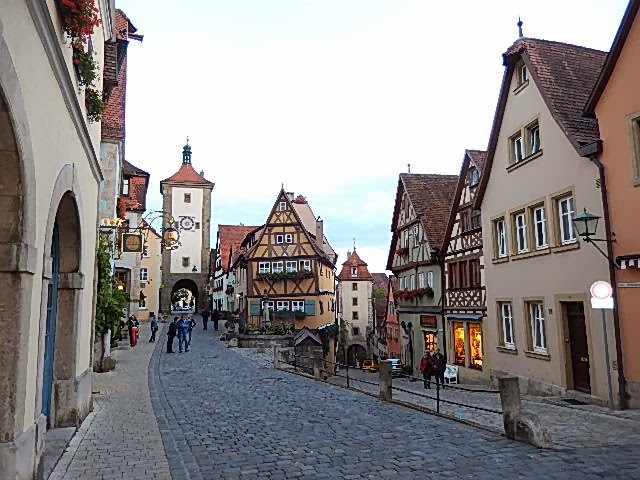
On Monday, September 9, we headed out to an old medieval town called Rothenburg ob der Tauber. For a couple of old history teachers, this was quite the place. As you can see in these pictures, it has maintained its medieval charm quite well. Being medieval, the town was surrounded by a high protective wall. You can walk atop it nearly the entire length around the town- it’s about a 2-mile walk and this picture below shows the covered walkway on
Atop the wall
 top of the wall. More good food here-- I chose some schnitzel this time!

When Wednesday rolled around, it was time to board the train to Nürnberg, or Nuremberg as we know it. After finding a hotel, we took a stroll around the old part of town and came upon a Pizza Hut. That really sounded good so we ducked in and had some Italian for a change. The next day we toured the Nazi Documentation Center; they have done an excellent job in telling the story of the rise of the Nazi Party without pushing any agenda. The stories and displays pretty much lead you to the obvious conclusions. It’s good to have this kind of place lest we forget; as a matter of fact, there were several German army personnel taking the tour at the time we were there. I wonder if it is a requirement? We were able to walk
Zeppelin Field
over to Zeppelin Field where the large Nazi rallies were held and you can actually walk up to the reviewing platform that Hitler would have stood upon while reviewing the thousands of troops lined up before him. It was really a somewhat eerie feeling to be there. Again, a couple of old history teachers just really ate it up! We also visited the Albrecht Dürer museum which happens to be the home in which he lived in Nürnberg. He was a famous artist.
Dürer home


On Friday, September 13, we left for Stuttgart on our third Eurail trip-- two to go! I’ll continue the trip in the next post. If you happen to follow my other blog “Happekotte Happenings”, you will find this exact same posting there.